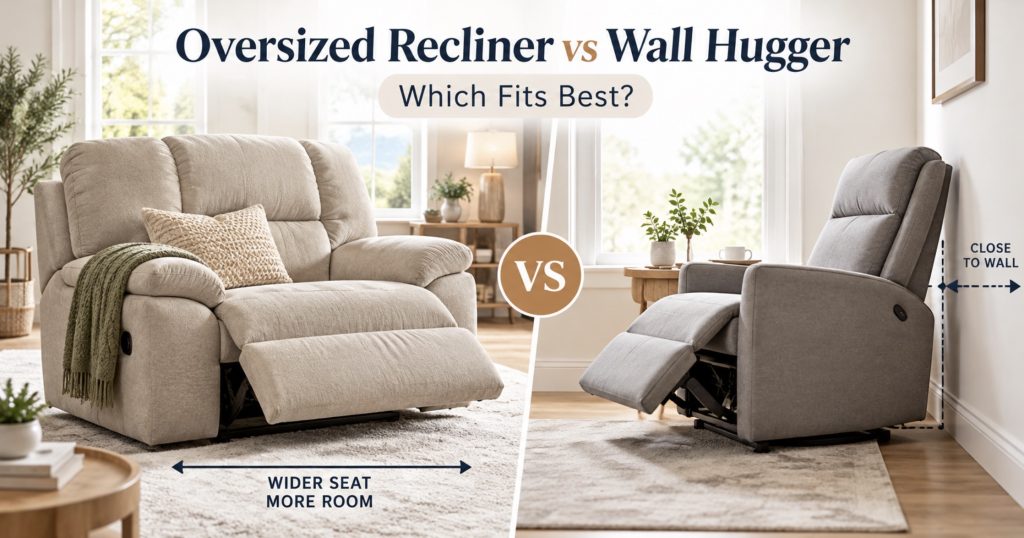
Looking for a recliner that actually fits your room? An oversized recliner gives you extra lounging space, while a wall-hugger lets you recline closer to the wall. But bigger does not always mean more comfortable, and wall-hugger does not always mean smaller. Here is how to compare both before buying.
- Oversized Recliner vs Wall Hugger: Quick Comparison
- What Is an Oversized Recliner?
- What Is a Wall-Hugger Recliner?
- Key Differences Between the Two
- How Much Space Does Each Recliner Need?
- How to Measure Your Room Before Buying
- Which Recliner Is More Comfortable?
- Which Is Better for Big and Tall Users?
- Best Recliner Type for Different Rooms
- Manual vs Power Reclining
- Frame, Mechanism, and Durability
- Leather vs Fabric Options
- Price and Long-Term Ownership Costs
- What to Look for When Shopping
- Common Buying Mistakes
- Which Recliner Should You Choose?
- Care and Maintenance Tips
- Frequently Asked Questions
Oversized Recliner vs Wall Hugger: Quick Comparison
The biggest difference is that “oversized” describes the chair’s dimensions and seating proportions, while “wall-hugger” describes how its reclining mechanism moves.
An oversized recliner is designed to provide more seating space, wider cushions, and often greater support for larger users. A wall-hugger recliner uses a forward-moving mechanism to reduce how much clearance the backrest needs behind the chair.
That means a recliner can actually be both oversized and wall-hugging.
| Feature | Oversized Recliner | Wall-Hugger Recliner |
|---|---|---|
| Main purpose | Extra seating room and comfort | Reduced rear-wall clearance |
| Chair width | Often 40–50+ inches | Varies from compact to oversized |
| Rear-wall clearance | Often 12–18+ inches on standard reclining mechanisms | Often around 3–6 inches, sometimes less |
| Reclining movement | Depends on its mechanism | Seat moves forward while reclining |
| Best for | Roomy seating, larger users, spacious living rooms | Apartments, smaller rooms, wall-side placement |
| Comfort advantage | Wider seat, generous padding, often longer support | Comfortable reclining without requiring a large gap behind |
| Small-room suitability | Depends on width and full-recline footprint | Usually better when rear clearance is limited |
| Main drawback | Can occupy considerable floor space | Still requires sufficient space in front |
Important: The measurements above are general shopping ranges, not specifications for every model. Some oversized recliners have wall-hugger mechanisms, while some wall-hugger chairs are quite wide. Always compare the exact manufacturer’s upright dimensions, required wall clearance, and fully reclined footprint.
What Is an Oversized Recliner?
An oversized recliner is a reclining chair designed with more generous proportions than a conventional single recliner. It often features a wider seat, broader armrests, deeper cushions, a tall backrest, and an extended footrest.
Some oversized recliners are marketed as big-and-tall chairs, while others are simply extra-roomy models designed for comfortable lounging.
Common Oversized Recliner Features
- Extra-wide seat cushions
- Thicker armrest padding
- Deep or overstuffed seating
- Tall, supportive backrests on some models
- Longer footrests or extended reclining length
- Manual or power reclining options
- Rocker, glider, or stationary bases
- Optional cup holders, heat, massage, or USB charging
- Higher weight capacities on selected big-and-tall models
Advantages of an Oversized Recliner
- More room to spread out: A wider seat gives your arms, hips, and legs more space.
- Roomy cushioning: Deep cushions and generously padded arms can feel especially comfortable during long sitting sessions.
- Options for larger body types: Some models provide increased seat width, back height, and weight capacity.
- Relaxed lounging: Extra seat room can be appealing for reading, watching television, or taking naps.
- More features: Many larger models offer power headrests, lumbar adjustment, extended footrests, or storage.
Disadvantages of an Oversized Recliner
- Requires more horizontal floor space
- May block walkways in narrow rooms
- Often heavier and harder to move
- Can be difficult to carry through doorways
- Very deep seating may feel uncomfortable for shorter users
- Some models need considerable clearance behind the chair
- Larger furniture can visually overwhelm smaller rooms
If you want extra room and thick cushioning, compare oversized recliner chairs with their actual seat width, depth, and reclining dimensions rather than relying on the word “oversized” alone.

Korser Oversized Recliner Chair, Extra Wide Rocking Chair with Massage and Heat, 360° Swivel Rocker Recliner for Adults, Nursery Chair with Side Pocket, Cashmere Reclining Sofa for Living Room, Beige

Korser Oversized Recliner Chair, Extra Wide Rocking Chair with Massage and Heat, 360° Swivel Rocker Recliner for Adults, Nursery Chair with Side Pocket, Cashmere Reclining Sofa for Living Room, Grey

HAOMARKETS Oversized Power Recliner Chair with Massage and Heat, 41" Wide Electric Reclining Chairs with USB Port, Breathable Fabric Overstuffed Reclining Sofa for Living Room Bedroom (No Lift)
What Is a Wall-Hugger Recliner?
A wall-hugger recliner, sometimes called a wall-saver recliner, is designed to operate closer to a wall than many traditional reclining chairs.
Instead of simply tipping the backrest far backward, a wall-hugger mechanism shifts the seat forward as the chair reclines. This reduces the space needed behind the chair.
For example, a conventional reclining mechanism might require roughly 12–18 inches behind the chair, while a wall-hugger may need only around 3–6 inches. The actual requirement varies by model.
How a Wall-Hugger Mechanism Works
The process typically follows these steps:
- The recliner starts in its upright position close to the wall.
- The user activates the manual lever, push-back action, or power control.
- The seat shifts forward as the backrest begins to recline.
- The footrest extends into the space in front of the chair.
- The backrest maintains a relatively small gap from the wall.
Not every wall-hugger recliner uses the same mechanism or follows exactly the same motion path. Some models move forward more than others.
Advantages of a Wall-Hugger Recliner
- Less rear clearance: The chair can often sit much closer to a wall.
- Flexible furniture placement: Ideal for rooms where placing furniture in the middle is inconvenient.
- Apartment-friendly: Useful when every inch of room depth matters.
- Convenient television seating: Allows a recliner to sit along a wall without giving up full reclining movement.
- Multiple size options: Available in compact, standard, and some oversized designs.
- Manual and power choices: Some models include powered headrests, USB ports, and other comfort features.
Disadvantages of a Wall-Hugger Recliner
- Still needs room in front for the footrest
- Forward movement can interfere with nearby coffee tables
- Mechanisms vary in smoothness and durability
- Some models have limited rocking or gliding options
- Not every wall-hugger is compact or lightweight
- Exact rear clearance can vary significantly between models
For limited rear space, compare wall-hugger recliner chairs and check how far each one extends forward when fully reclined.

QKFF Wall Hugger Power Recliner Chair, Zero Wall Electric Recliner, Leather | USB Port, Space-Saving, Smooth Quiet Motor, Sturdy Steel Frame, Easy-Clean Fabric, Perfect for RV & Home Theater

QKFF Wall Hugger Power Recliner Chair, Zero Wall Electric Recliner, Velvet
Key Differences Between Oversized and Wall-Hugger Recliners
1. Size vs Reclining Mechanism
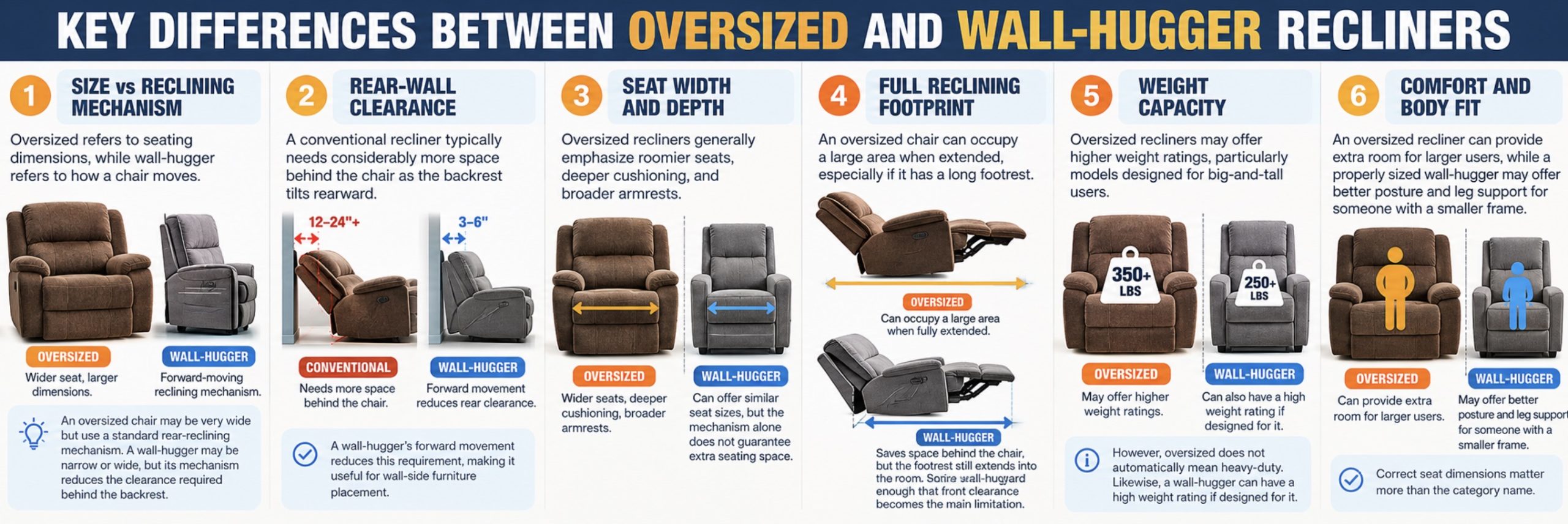
The main distinction is that oversized refers to seating dimensions, while wall-hugger refers to how a chair moves.
An oversized chair may be very wide but use a standard rear-reclining mechanism. A wall-hugger may be narrow or wide, but its mechanism reduces the clearance required behind the backrest.
Do not treat the two categories as opposites. They describe different features.
2. Rear-Wall Clearance
A conventional recliner typically needs considerably more space behind the chair as the backrest tilts rearward.
A wall-hugger’s forward movement reduces this requirement, making it useful for wall-side furniture placement.
3. Seat Width and Depth
Oversized recliners generally emphasize roomier seats, deeper cushioning, and broader armrests.
Wall-hugger recliners can offer similar seat sizes, but the mechanism alone does not guarantee extra seating space.
4. Full Reclining Footprint
An oversized chair can occupy a large area when extended, especially if it has a long footrest.
A wall-hugger saves space behind the chair, but the footrest still extends into the room. Some wall-huggers move the entire seat forward enough that front clearance becomes the main limitation.
5. Weight Capacity
Oversized recliners may offer higher weight ratings, particularly models specifically designed for big-and-tall users.
However, oversized does not automatically mean heavy-duty. Likewise, a wall-hugger can have a high weight rating if designed for it.
6. Comfort and Body Fit
An oversized recliner can provide extra room for larger users, while a properly sized wall-hugger may offer better posture and leg support for someone with a smaller frame.
Correct seat dimensions matter more than the category name.
How Much Space Does Each Recliner Need?
The most common buying mistake is measuring only the chair’s upright dimensions.
A recliner needs enough space to operate through its entire movement path without hitting walls, furniture, rugs, or walkways.
Typical Planning Measurements
| Measurement | Oversized Standard Recliner | Wall-Hugger Recliner |
|---|---|---|
| Upright width | Often 40–50+ inches | Varies widely; many standard models are roughly 30–40 inches |
| Upright depth | Often about 38–45+ inches | Often about 35–42 inches |
| Behind-chair clearance | Plan around 12–18+ inches if not wall-saving | Often around 3–6 inches |
| Front clearance | Must accommodate the extended footrest | Must accommodate both the forward seat movement and footrest |
| Walking clearance | Allow room around the chair’s full operating footprint | Allow room around the chair’s full operating footprint |
These figures are approximate planning ranges. The full-recline dimensions published by the manufacturer are more useful than any generic measurement.
Why Front Clearance Matters
A wall-hugger placed only a few inches from the wall can still obstruct a living room if there is a coffee table directly in front of it.
For example, a recliner may fit comfortably when upright but leave almost no room between its extended footrest and the coffee table.
The goal is not just to fit the chair into the room. It is to fit the chair while fully reclined and preserve the space needed to walk safely.
How to Measure Your Room Before Buying
Before deciding between an oversized recliner and a wall-hugger, grab a tape measure and map out where the chair will go.
Step 1: Measure the Available Room Width
Measure the space between the nearest walls, tables, sofa arms, cabinets, or other furniture.
Remember to allow space for:
- The recliner’s full outside width
- Armrest clearance
- Getting into and out of the chair
- Nearby drawers or cabinet doors
- Walkways around the chair
Step 2: Measure the Room Depth
Measure from the rear wall to the nearest object in front of the chair, such as a coffee table, media console, or another seat.
This measurement determines whether the recliner can extend comfortably.
Step 3: Check Required Rear Clearance
Find the recliner’s minimum wall-clearance specification.
If the listing only says “wall-hugger” without stating the actual clearance requirement, ask the manufacturer or seller for the figure.
Step 4: Find the Fully Reclined Length
Check the product’s fully extended depth or total reclining length.
Do not assume all recliners with the same upright depth extend the same distance.
Step 5: Measure the Walking Path
A practical goal is to maintain roughly 30–36 inches of comfortable passage where people regularly walk, when the room allows it. Narrower areas may be workable, but accessibility or building requirements can demand more.
Step 6: Check the Delivery Route
Even when an oversized recliner fits the living room, it may not fit through the front door, hallway, staircase, or elevator.
Measure:
- Doorway clear opening
- Hallway width
- Stairwell turns
- Elevator interior dimensions
- Shipping carton dimensions
- Chair dimensions with the backrest removed, if detachable
Step 7: Mark the Footprint on the Floor
Use painter’s tape to outline the chair in both upright and fully reclined positions.
This simple test shows whether the footrest will reach the coffee table, block a walkway, or interfere with another piece of furniture.
You can also use the Will This Recliner Fit? calculator to compare your room dimensions against the clearance and size of the recliner you are considering.
Simple Space Calculation Example
Imagine a room with 90 inches of usable depth between the wall and a coffee table.
You find two recliners:
- Oversized recliner: Requires a rear gap of 16 inches and has a fully reclined depth of 68 inches, measured from the rearmost chair point to the footrest tip.
- Wall-hugger recliner: Requires a rear gap of 4 inches and has a fully reclined depth of 70 inches.
For a simplified conservative comparison:
- Oversized standard recliner: 16 + 68 = 84 inches
- Wall-hugger recliner: 4 + 70 = 74 inches
That leaves approximately 6 inches for the first chair and 16 inches for the second chair before reaching the coffee table.
These are illustrative measurements, not product specifications, and assume the published reclined depth excludes the extra wall gap. Always confirm how the manufacturer defines its dimensions.
In this example, neither setup provides a comfortable passage in front. Moving the coffee table may be necessary even with the wall-hugger.
Which Recliner Is More Comfortable?
Comfort depends on body size, posture, cushion quality, support, and reclining position—not simply whether the chair is oversized or wall-hugging.
Seat Width
A wider seat can be comfortable for users who prefer more room around their hips and legs.
However, a seat that is too wide may make the armrests difficult to reach comfortably.
Seat Depth
Deep seating allows taller users to sit farther back and stretch out.
For shorter users, an excessively deep seat can prevent their back from resting comfortably against the backrest while their feet reach the floor.
Backrest Height
A taller backrest may provide better head and neck support for tall users, but height alone is not enough. The headrest should meet the head at a comfortable position.
Footrest Length
An extended footrest is especially helpful for taller users who otherwise find that their calves or heels hang off the end.
Check the actual extended footrest support rather than just the total reclining length.
Cushion Firmness
Some oversized recliners use very soft, overstuffed cushions, but softer is not automatically better.
Cushions that compress too much can cause poor posture, uneven support, or difficulty standing up.
Reclining Position
Both oversized and wall-hugger recliners can offer comfortable reclining angles.
However, exact movement, recline depth, and the ability to position the back and footrest independently depend on the mechanism and motor setup.
Best comfort rule: Choose a recliner that supports your back, head, thighs, and legs correctly when upright and reclined. Extra width is helpful only when it improves the actual fit.
Which Is Better for Big and Tall Users?
If you are taller, heavier, or broad-shouldered, an oversized recliner may be more comfortable because it can provide a wider seat, taller backrest, longer leg support, and a higher weight rating.
However, a wall-hugger recliner can offer those same advantages if it is specifically built in a big-and-tall size.
Measurements That Matter for Larger Users
- Seat width: Measure the usable cushion width between the armrests, not just the chair’s outside width.
- Seat depth: The thighs should be supported without the cushion pressing uncomfortably behind the knees.
- Backrest height: Tall users should check whether their head and shoulders are fully supported.
- Footrest length: Compare the extended support length with your leg length.
- Weight capacity: Choose a manufacturer-rated capacity appropriate for the user.
- Frame construction: Check for reinforced wood or steel components.
- Mechanism rating: Look for durable reclining hardware designed for frequent use.
Oversized Recliner for Larger Users
An oversized chair is worth considering when you need a seat wider than standard, more leg support, or a taller back.
A big-and-tall oversized recliner can be a useful shopping category, but verify the seat measurements and rated capacity for each specific model.

Takywep Oversized Electric Recliner Chair with 2 Memory Presets | Lumbar Support & Cup Holder – Cozy Chenille Accent Chair for Living Room, Big & Tall Adults, Elderly, Pregnant Women – Gray

CANMOV Large Power Lift Recliner Chair with Massage and Heat for Elderly Big and Tall People, Overstuffed Wide Recliners with 2 Cup Holders, Side Pocket and USB Port, Camel

Neioml Triple Motor Large-Wide Lift Chair, Infinite Position, 180° Lay Flat, Power Lift Chairs Recliners for Elderly Big and Tall, Massage & Heat, Extended Footrest (Dark Brown, Large Wide)
Wall-Hugger for Larger Users
A big-and-tall wall-hugger combines roomy seating with a mechanism that requires less rear clearance.
This can be an excellent option when a large user needs extra seat width but the recliner must stay near a wall.
For more details about body dimensions, seat support, weight ratings, and extended length, see the Best Recliner for Big & Tall: Buyer’s Guide.
Best Recliner Type for Different Rooms
Small Apartments
A wall-hugger is often the more practical choice because it can sit closer to the wall without losing its reclining function.
Look for:
- Compact outside width
- Minimal rear clearance
- Shorter upright depth
- Appropriate front footrest clearance
- Detachable backrest for delivery
Large Living Rooms
An oversized recliner can be a great option when there is plenty of room around the chair.
It offers more seating space, substantial cushioning, and a relaxed appearance.
Bedrooms
A compact wall-hugger may fit better beside a wall or window where space is limited.
Make sure the extended footrest does not block closet doors, drawers, or the path to the bed.
Home Theater Rooms
Wall-huggers are useful in rows of seating because they can reduce rear clearance.
Oversized home-theater recliners offer generous seat width, arm storage, cup holders, and long-session comfort.
If the theater room is large enough, an oversized wall-hugger may offer both advantages.
Nurseries
A compact glider or swivel recliner is often practical for a nursery.
However, not every wall-hugger includes a rocking or gliding feature. Check the specific base mechanism if soothing movement is important.
RV and Camper Interiors
Compact wall-saving recliners can be useful where rear clearance and furniture width are limited.
RV installations also require special consideration for weight, safe mounting, slide-out clearance, and movement during travel.
For additional ideas, see Best Small Recliners for Campers.
Open-Concept Living Spaces
An oversized recliner can fit naturally into a large seating arrangement.
If the chair needs to sit along the wall to preserve the center of the room, a wall-hugger may be easier to position.
Manual vs Power Reclining: Does It Matter?
Both oversized and wall-hugger recliners are available in manual and powered designs.
The choice affects convenience, positioning control, electrical requirements, and future maintenance.
Manual Oversized Recliners
Manual oversized recliners usually operate using a pull handle, lever, or push-back mechanism.
Advantages include:
- No need for an electrical outlet
- Usually fewer electronic components
- Straightforward daily operation
- Potentially lower long-term electrical repair costs
Disadvantages include:
- Can require more physical effort
- May have limited reclining positions
- Closing a heavy footrest can be difficult for some users
Power Oversized Recliners
Power oversized recliners typically use one or more electric actuators.
Advantages include:
- Convenient push-button control
- Gradual adjustment
- Optional power headrest and lumbar support
- Available independent backrest and footrest controls on some models
Disadvantages include:
- Requires electricity or a compatible battery system
- Motors, control boxes, switches, and transformers can fail
- May cost more than a comparable manual model
Manual Wall-Hugger Recliners
Manual wall-huggers can provide space-saving movement without electrical components.
These are worth considering if you want simple operation in an apartment or smaller living room.
Power Wall-Hugger Recliners
Power wall-huggers combine forward-moving reclining mechanisms with powered positioning.
Look for:
- Minimum rear clearance specification
- Full reclining dimensions
- Number of motors
- Power headrest availability
- USB charging features
- Power supply and battery backup options
- Replacement actuator and control availability
You can compare power wall-hugger recliners if you want adjustable reclining without pulling a manual lever.

Korser Power Recliner Chairs for Adults, Wall Hugger RV Recliner with USB & Type-C Charging Ports, Zero Gravity Electric Power Recliner Chair for Living Room Home, Theater Seating, Bedroom

KISLOT Wall Hugger Recliner Chair, Faux Leather Power Reclining, Brown, 1PC | USB Charging Ports, Electric RV Recliner, Home Theater Seating, Living Room, Bedroom
Frame, Mechanism, and Durability Differences
The overall build quality matters more than the oversized or wall-hugger label.
A well-constructed recliner should have a stable frame, properly supported seating, durable hinges, smooth moving parts, and hardware designed for its intended load.
Frame Materials
Common materials include:
- Hardwood
- Engineered wood
- Plywood
- Steel reinforcement
- Mixed wood-and-metal construction
Construction quality and joint design are more important than the material name alone. A properly engineered combination frame can outperform a poorly assembled solid-wood frame.
Reclining Mechanism
Standard oversized recliners and wall-huggers may use different linkage arrangements.
Wall-hugger mechanisms are designed to shift the chair forward during recline, while conventional reclining mechanisms may require more back clearance.
Check for:
- Smooth operation
- Minimal side-to-side movement
- Secure mounting brackets
- Accessible replacement components
- Manufacturer support and warranty
Springs and Cushion Support
Seat support systems may include sinuous springs, webbing, foam, or other suspension components.
High-quality cushioning should maintain comfort and support without quickly flattening or sagging.
Weight Rating
Do not assume that a wider chair automatically supports more weight.
Check the stated weight rating and intended usage. Heavy-duty ratings should come from the manufacturer rather than product-description claims alone.
Serviceability
Before buying, consider whether replacement parts are available for:
- Recliner handles
- Release cables
- Springs
- Footrest mechanisms
- Power actuators
- Power supplies
- Control boxes
- Remotes and switch panels
Even a comfortable recliner can be frustrating to own if a minor failed component cannot be replaced.
Leather vs Fabric: Which Works Better?
Both oversized and wall-hugger recliners are available in different upholstery materials.
Leather Recliners
Leather can provide a smooth, premium appearance and can be comfortable for everyday lounging.
Advantages:
- Attractive finish
- Often easy to wipe clean
- Can age well when properly maintained
- Available in a variety of colors and textures
Disadvantages:
- Can cost more
- May feel cool or warm depending on room temperature
- Requires suitable cleaning products
- May scratch or fade with use
Fabric Recliners
Fabric is popular for oversized chairs because of its soft feel and wide variety of designs.
Advantages:
- Soft, comfortable surface
- Wide color and texture selection
- Often less slippery than smooth leather
- Performance fabrics can resist stains and wear
Disadvantages:
- Can absorb spills
- May trap dust or pet hair
- Some materials pill or wear over time
- Cleaning requirements vary by fabric
Faux Leather and Leather-Match Recliners
These can provide a leather-like appearance at a lower purchase price.
However, durability varies considerably. Some synthetic surfaces may crack or peel as their coating ages, especially in high-contact areas.
Choose upholstery based on actual material specifications, comfort, cleaning requirements, and expected use.
Price and Long-Term Ownership Costs
Oversized recliners often cost more than smaller chairs because they may require more upholstery material, cushioning, and structural support.
Wall-hugger pricing varies widely because the mechanism is only one part of the chair’s overall design.
What Affects Recliner Prices?
- Chair size
- Manual or power mechanism
- Number of motors
- Frame construction
- Weight capacity
- Cushion quality
- Leather or fabric upholstery
- Power headrest and lumbar options
- Heat and massage functions
- Brand warranty and retailer service
Maintenance Costs
Manual recliners may eventually require replacement handles, cables, springs, or linkage components.
Power recliners may require a replacement motor, transformer, remote, control box, or switch panel.
A chair with readily available replacement parts can be easier to maintain over the long term.
Delivery Costs
Oversized recliners may require special handling, additional delivery assistance, or assembly.
Check whether the backrest can be detached and whether old-furniture removal is included with delivery.
Warranty Coverage
Read the warranty carefully. Different components may have different coverage periods.
Look at:
- Frame warranty
- Mechanism warranty
- Motor and electronics warranty
- Cushion coverage
- Upholstery coverage
- Labor and service charges
- Shipping responsibility for replacement parts
What to Look for When Shopping
A few measurements and specifications can save you from buying the wrong recliner.
1. Confirm the Real Seat Width
Do not confuse outside width with usable seat width. Wide padded arms can make a chair look enormous without providing much extra seating space.
2. Check the Upright and Reclined Dimensions
Look for separate dimensions for:
- Upright width
- Upright depth
- Upright height
- Fully reclined depth
- Required wall clearance
- Extended footrest support
3. Verify the Weight Capacity
Look for a specific manufacturer rating.
Do not assume the word “oversized” guarantees increased capacity.
4. Check Seat Height
A seat that is too low or too high can make standing up uncomfortable.
5. Examine the Footrest Design
Check whether it supports the calves and heels properly when fully extended.
6. Consider the Reclining Controls
Choose between manual, single-motor power, and multi-motor systems based on how much adjustment you actually need.
7. Check the Mechanism Type
Some wall-huggers do not rock, while some oversized recliners do not swivel. Confirm any movement feature that matters to you.
8. Verify Delivery Dimensions
Check cartons, detachable components, and the delivery path into your room.
9. Read the Return Policy
Large furniture can be expensive to return, especially if the chair must be repacked or collected by a freight carrier.
10. Compare Real Customer Feedback
Look for comments about long-term cushioning, reclining smoothness, motor noise, fit, upholstery wear, and warranty service.
KISLOT Wall Hugger Recliner Chair, Faux Leather Power Reclining, Grey, 1PC

Korser Recliner Chair, Wall Hugger Recliners for RV with Massage and Heating, Zero-Gravity Recliner, Electric Power Recliner Chair for Living Room, Bedroom, Home, Theater Seating (Darkgray)

KISLOT Wall Hugger Recliner Chair for Adults, Faux Leather RV Recliner with USB Charging Ports Electric Power Reclining Sofa for Living Room Home Theater Seating Bedroom
Common Mistakes to Avoid
- Choosing based on appearance: A recliner may look compact in photos but have a large fully extended footprint.
- Assuming oversized means heavy-duty: Check the rated weight capacity separately.
- Assuming all wall-huggers are narrow: Wall-hugger mechanisms are available on wider chairs too.
- Ignoring front clearance: Wall-huggers save rear space but still extend forward.
- Measuring only the room: Check doorways and hallways before delivery.
- Buying a seat that is too deep: A deep oversized recliner can be uncomfortable for shorter users.
- Overlooking footrest length: Taller users may need more leg support than the chair provides.
- Ignoring the recline mechanism: Not all chairs rock, swivel, glide, or recline in the same way.
- Choosing too many features: Extra electronics add convenience but also additional components to maintain.
- Skipping warranty details: A good warranty can matter more than minor differences in purchase price.
Which Recliner Should You Choose?
The better choice depends on your room layout, body dimensions, and preferred seating experience.
Choose an Oversized Recliner If:
- You have a spacious living room
- You prefer an extra-wide seat
- You need more room around your hips and shoulders
- You want deep cushions and generous arm padding
- You are shopping for a big-and-tall model
- You have sufficient front and rear clearance
- You prefer a relaxed, spacious lounging experience
Choose a Wall-Hugger Recliner If:
- You need to place the chair near a wall
- You live in an apartment or smaller home
- You want to preserve floor space behind the chair
- The chair will sit along a wall in a home theater
- You need more flexibility when positioning furniture
- You have sufficient space in front for the footrest
Choose an Oversized Wall-Hugger If:
- You want a wider seat but have limited rear clearance
- You are a taller or larger user with a relatively compact room
- You want a big-and-tall recliner positioned against a wall
- You need extra comfort without placing the chair far into the room
A useful search is oversized wall-hugger recliners, which combine generous seating dimensions with a forward-moving reclining mechanism.
Care and Maintenance Tips
Whether you buy an oversized recliner or a wall-hugger, regular care helps keep the chair comfortable and reduces avoidable mechanical problems.
- Vacuum underneath regularly: Remove dust, pet hair, and debris from the base and linkage.
- Check moving parts: Inspect visible pivots, springs, and brackets for unusual wear.
- Keep clearance areas open: Avoid trapping cords, rugs, or objects behind and underneath the chair.
- Do not overload the footrest: Avoid sitting or standing on it.
- Use smooth reclining movements: Do not slam manual recliners open or closed.
- Inspect power cables: Keep electrical cords away from moving mechanisms.
- Lubricate only approved pivots: Follow the manufacturer’s instructions rather than spraying every moving part.
- Clean upholstery appropriately: Use products recommended for the exact leather or fabric type.
- Check mounting hardware: Investigate loose bolts, unusual noises, or uneven movement.
- Stop if the chair binds: Grinding, twisting, or sudden resistance should be checked before continued use.
Frequently Asked Questions
What is the main difference between an oversized recliner and a wall-hugger?
An oversized recliner refers to a chair with generous seating dimensions, while a wall-hugger describes a reclining mechanism that moves forward to reduce rear-wall clearance. A recliner can have both features.
Are wall-hugger recliners smaller than regular recliners?
Not necessarily. Some wall-huggers are compact, but others have wide seats, tall backs, and oversized dimensions. Wall-hugger describes the mechanism, not the overall chair size.
How close can a wall-hugger recliner sit to the wall?
Many require around 3–6 inches of rear clearance, although some designs need less or more. Always confirm the exact manufacturer’s specification before placing the chair.
How much space does an oversized recliner need behind it?
An oversized recliner with a conventional reclining mechanism may require around 12–18 inches or more behind the backrest. An oversized model with a wall-hugger mechanism can require much less.
Are oversized recliners more comfortable?
They can be more comfortable for users who need extra seating width, cushion depth, or leg support. However, an oversized chair that is too deep or wide may be less comfortable than a properly fitted standard recliner.
Are wall-hugger recliners good for tall people?
Yes, if the model has a suitable backrest height, seat depth, footrest length, and weight rating. A wall-hugger mechanism does not automatically limit the chair to smaller users.
Can an oversized recliner also be a wall-hugger?
Yes. Some oversized and big-and-tall recliners include wall-saver mechanisms. These combine roomy seating with reduced rear clearance.
Do wall-hugger recliners need space in front?
Yes. The footrest still extends forward, and the seat may move forward during reclining. Always measure the full operating footprint rather than only the gap behind the chair.
Do wall-hugger recliners recline as far as regular recliners?
Some provide comparable reclining angles, while others have different travel limits. The maximum recline angle depends on the actual mechanism and model.
Are wall-hugger recliners more expensive?
Not always. Prices depend on the brand, construction, upholstery, motors, and other features. A basic manual wall-hugger may cost less than a luxury oversized power recliner.
Are oversized recliners stronger than standard recliners?
Not automatically. A larger chair does not necessarily have a higher weight rating. Check the manufacturer’s stated capacity, frame design, and mechanism specifications.
Can a wall-hugger recliner rock or swivel?
Some models can, but many use stationary wall-saving mechanisms. Rocking, gliding, and swiveling should be confirmed individually rather than assumed.
Which recliner is better for a small apartment?
A compact wall-hugger is often more practical because it can operate near a wall. However, its extended footrest still needs enough room without blocking important walkways.
Which recliner is better for watching television?
Either can work well. An oversized chair offers spacious lounging, while a wall-hugger is useful for seating arranged close to a wall. Head and neck support, viewing angle, and comfort matter more than the category.
Is a power wall-hugger better than a manual oversized recliner?
That depends on whether you value electrical adjustment and reduced rear clearance more than roomy seating and simpler operation. Compare your space, comfort preferences, and maintenance needs.
Can I put an oversized recliner against the wall?
Yes, but only if the model’s reclining mechanism allows enough clearance. A conventional recliner pushed too close to the wall may hit it when reclining.
Do I need to measure a recliner when it is fully extended?
Yes. Fully reclined dimensions are essential because a chair that fits upright may block furniture or walkways once the footrest opens.
Which recliner lasts longer?
Neither type is automatically more durable. Longevity depends on frame quality, mechanism design, upholstery, maintenance, weight loading, and the availability of replacement parts.
What is a zero-wall recliner?
Zero-wall is a marketing term often used for recliners designed to operate with very little clearance behind the chair. It does not necessarily mean literally zero inches. Check the manufacturer’s actual clearance requirement.
Which recliner should I buy if I want both comfort and space savings?
Consider an oversized wall-hugger with a seat width, back height, footrest length, and weight capacity that suit your body. Confirm the fully reclined footprint so the chair does not block the front of the room.
Conclusion
An oversized recliner is great when you want more room to relax, while a wall-hugger is ideal when rear space is limited. Neither is automatically better. Measure your room, compare the fully reclined footprint, check seat comfort, and choose the model that fits both your body and your living space.
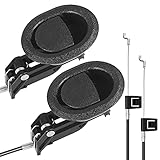
Baridwon Recliner Lever Parts, Handle with Exposed Cable 4.75in, 2 Sets | Recliner mechanism repair kit: release pull handle and cable for sofa, couch, chair; compatible with most furniture
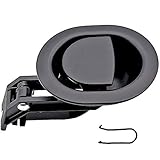
ttmagic Universal Heavy-Duty Metal Sofa Chair Recliner Release Pull Handle Replacement Parts, Fits Ashley, Lazy Boy and Most Recliner Brands, 3.5"L x 3"W x 1.2"H Handle Size
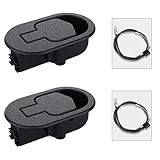
Baridwon 2 Set Recliner Replacement Parts, Durable Recliner Release Pull Handle with Recliner Pull Cable, Repair Replacement Parts Compatible with Most Furniture of Recliner Chair Sofa Couch

ttmagic Metal Recliner Handle Replacement Parts with Cable, Universal Recliner Sofa Chair Couch Release Lever Pull Handle, Fits Ashley and Major Recliner Brands, Exposed Cable Length 4.9“

ttmagic 2Pcs Metal Recliner Handle Replacement Parts with Cable, Universal Sofa Chair Couch Release Lever Pull Handle, Fits Ashley and Most Recliner Sofa Brand, Exposed Cable Length 4.9"